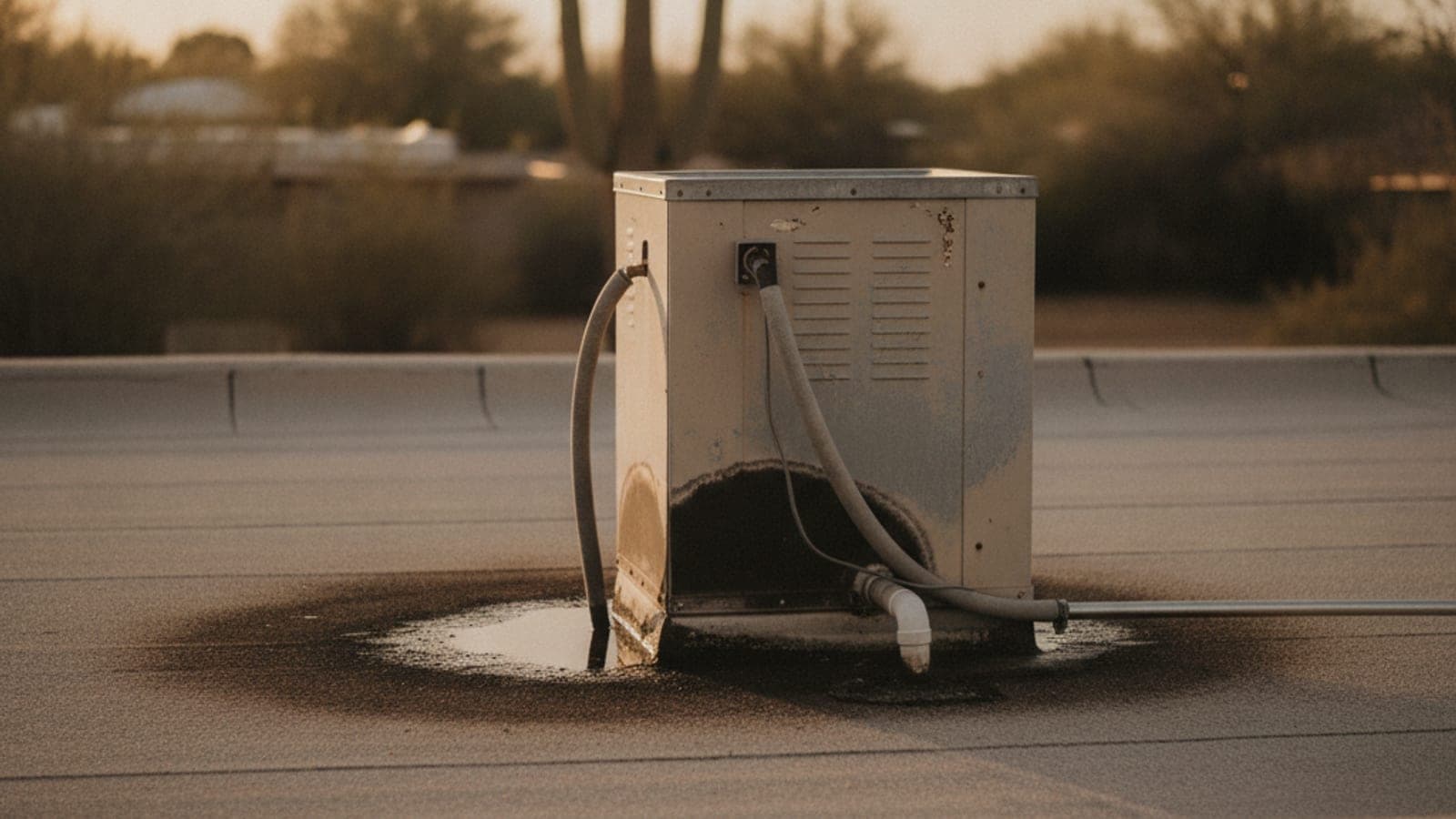
Shut off the cooler’s water and pump first. Then work out whether the leak comes from the cooler or from the roof, because the fix and the person you call are different. A leak only after a monsoon storm points at the roof. A leak while the cooler is running on a dry day points at the cooler.
Climate Pros Tucson is a referral service, so this is a way to sort the problem before you call anyone.
What should you do first?
- Turn the cooler’s water supply and pump off. Leave the fan off too if water is dripping through the ceiling.
- Move furniture, put a bucket under any drip, and move electronics away from the wet spot.
- If water is near a light fixture or outlet, switch off the breaker for that area.
- Take photos of the stain and the roof area when you can do so safely. Don’t climb on a wet roof.
How can you tell a cooler leak from a monsoon roof leak?
The timing is the clue.
- Stain appears only after rain: suspect the roof, flashing or the roof jack seal, not the cooler.
- Stain appears while the cooler runs on a dry day: suspect the cooler’s water system.
- Stain grows after you turn the cooler on and stops when the water is off: the cooler is feeding it.
- Stain shows up in both cases: the roof opening around the cooler may be leaking in both ways. Get both checked.
Tucson’s official monsoon runs June 15 through September 30, and strong winds and flash flooding are among the hazards tied to that window. Wind-driven rain reaches seams that stay dry the rest of the year.
What are the common causes inside the cooler?
- Float valve stuck open or set too high. The pan keeps filling and overflows. Check the float arm and the fill level against the manual.
- Rusted or cracked pan. Tucson Water notes that hard water builds calcium deposits in evaporative coolers. Scale and rust can eat at the pan and leave a slow leak at the seams.
- Clogged distribution lines or dry pads. Water runs where it shouldn’t, down the cabinet instead of through the pads.
- Drain or overflow fitting blocked or loose. Water backs up and spills over the edge of the pan.
- Pump line or fitting leak. A cracked tube or loose clamp sprays or drips inside the cabinet.
Our pad guide covers the scale side.
What are the common causes on the roof?
- Roof jack seal or flashing where the cooler’s duct goes through the roof has failed.
- Cracked sealant or a worn roof surface around the cooler’s curb or stand.
- Water pooling on a flat roof near the cooler because of low spots or a clogged drain.
- The cooler’s ceiling duct or damper, where rain that gets past the roof jack can run down into the house.
Who do you call, a roofer or an HVAC pro?
- Roof jack, flashing, sealant or ponding: a roofer, who can also check the roof around the cooler.
- Float valve, pump, pan, lines or fittings: an HVAC pro who works on evaporative coolers, or the cooler’s maker.
- Unclear or both: start with whichever fits the timing clue above, and tell them what you saw.
Not every HVAC pro works on evaporative coolers, so ask that question first when you call. If you decide to move to refrigerated air, that’s a job we can match you with.
Can you stop the damage meanwhile?
Keep the water off until it’s found. Dry the ceiling with fans and open air where it’s safe. A stain that keeps growing, a sagging ceiling or any smell of mold needs attention soon. Ask your insurer or a roofer about wet ceiling material.
When the leak keeps coming back
If the cooler is old, scaled and leaking again, it may be time to weigh switching. Our swamp cooler vs AC guide lays out the tradeoffs, and monsoon humidity and your AC explains why coolers fade in July and August. Matched pros handle AC installation and AC repair across the Tucson area.
Call (520) 353-2520 and we’ll match you with a licensed local pro.