HVAC and AC repair across the Tucson area.
Pages for 40 places from Marana to Green Valley and up to Mount Lemmon. Climate Pros Tucson matches you with a licensed local company, and that company confirms the visit and the price.
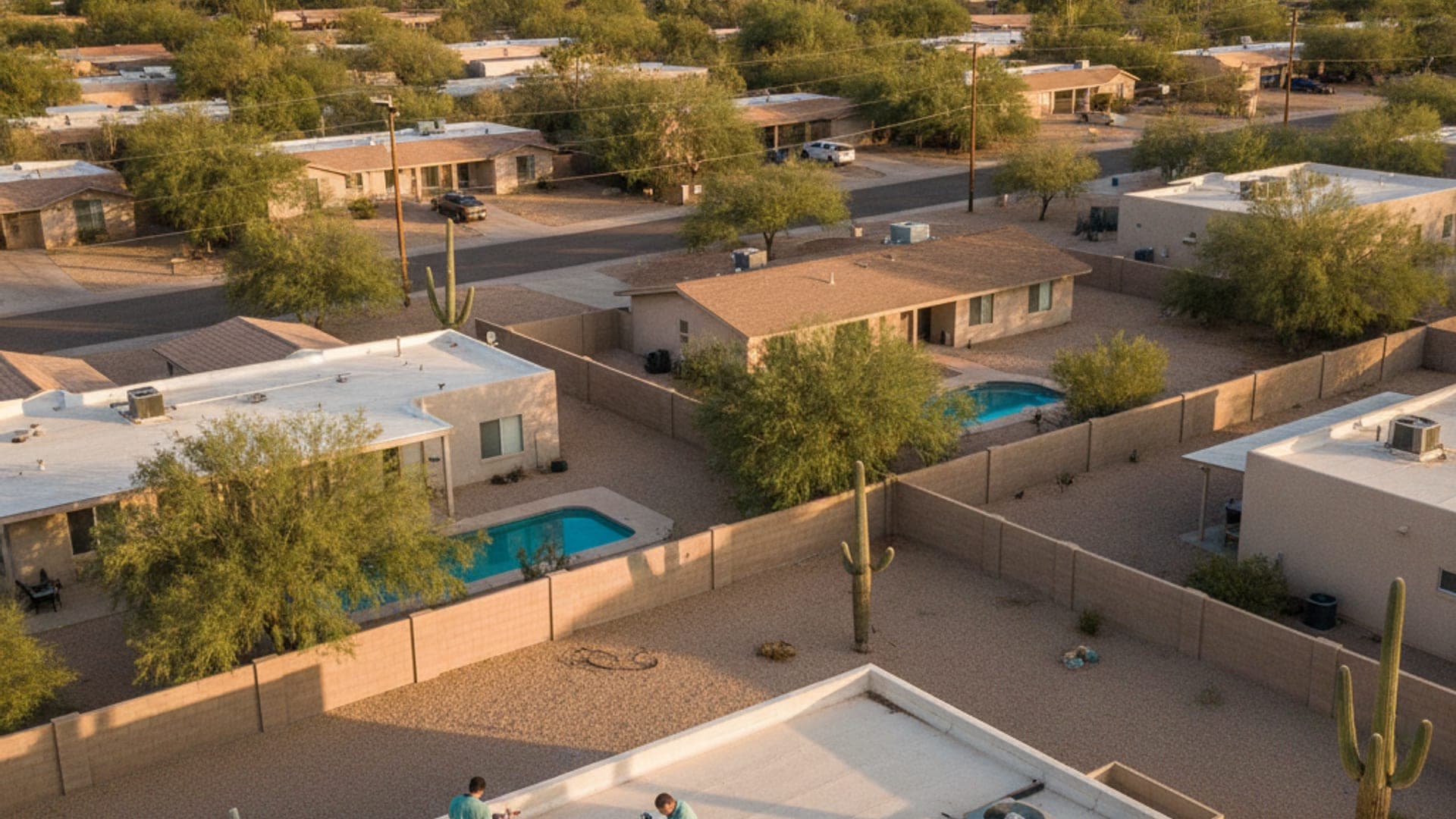
How does HVAC work change across the Tucson area?
Heat runs the calendar. The 1991-2020 normals at Tucson International Airport average about 68 days a year at or above 100F, and the National Weather Service counted a record 112 in 2024. Then the monsoon, June 15 to September 30, adds humidity, dust storms and the week your evaporative cooler stops keeping up. Winters on the valley floor are mild, with fewer than 12 freezing nights a year at the airport.
The job still changes by place. Central Tucson has the oldest houses, with roof units, coolers and retrofits. Marana, Vail and Sahuarita are newer tracts whose builder systems are reaching first replacement. Oro Valley, SaddleBrooke and Green Valley skew older in population. Mount Lemmon sits in code climate zone 5B, where heat matters more than cooling. Open your place below for the details, then call (520) 353-2520.
Climate Pros Tucson refers the job. You contract with and pay the independent licensed company directly. If TEP is your utility, its summer Time-of-Use peak runs 3 to 7 p.m. on weekdays from May to September, and its Efficient Home Program lists rebates at tep.com.
Which systems do the pros we send work on?
Central AC and split systems
A ground-set condenser with an indoor coil and air handler. In Tucson heat the usual failures are capacitors, contactors, condenser fan motors, refrigerant leaks and coils that freeze when airflow drops.
Heat pumps
The sensible default for a Tucson-basin home: the area needs about 2.6 cooling degree days for every heating degree day, and the City of Tucson winter design temperature is 35F. On cold mornings a heat pump steams during defrost, which is normal. Mount Lemmon is the exception.
Roof package units and gas packs
Everything in one box on the roof, cooling only or with gas heat. Replacing one raises crane access, roof condition and whether to move the equipment to the ground.
Gas furnaces
Southwest Gas is the area gas utility, and its 2026 Arizona rebate application lists no furnace rebate. Ignitors and flame sensors tend to show their problems on the first cold night after months idle.
Evaporative (swamp) coolers
Cheap to run in dry months, weaker in the monsoon: airport dew points sit in the 20s most of the year and jump into the high 50s in July and August. Tucson Water says hard water scales coolers and advises changing pads regularly and adding an in-line filter.
Ductless mini splits
For rooms the main system misses: Arizona rooms, converted garages, casitas and older adobe or block homes without ducts. TEP has listed a mini split rebate for its customers through participating contractors.
Ductwork
ENERGY STAR says a typical forced-air house can lose about 20% to 30% of the air moving through its ducts. The EPA recommends cleaning ducts only for visible mold, vermin or heavy debris, so sealing usually matters more than cleaning.
Indoor air quality
The monsoon window brings extreme heat, strong winds, dust storms and wildfire smoke. Better filtration your system can actually move air through, and a filter change after a dust storm, do most of the work.
More detail: AC not cooling checklist · Swamp cooler vs AC in Tucson · Roof package unit replacement · The 5,000 rule · Checking an ROC license · AC died in the heat: what to do while you wait
Central Tucson
Central Tucson is the old core of the valley floor, from Downtown and the historic barrios through the University area, Midtown and the Northside to the Rillito, plus the separate City of South Tucson. Recorded plats here run back to the 1890s, and renters are a large share of households: the City of Tucson is 51.8% owner-occupied and South Tucson 34.4% (ACS 2020-2024).
West and South Valley
The West and South Valley is the valley floor west of the Santa Cruz River and south toward the airport: Tucson's Westside and Southside plus Drexel Heights, Valencia West, Tucson Estates and Summit. Housing runs from older plats near the river to Valencia West, where the ACS median home was built in 2008. Sampled elevations run about 2,490 to 2,650 feet, so the heat load matches the city core.
Avra Valley and Tucson Mountains
West of the Tucson Mountains the lots get big and the drives get long: the Tucson Mountains foothills, then Picture Rocks, Avra Valley and Three Points on the open desert. Ranchettes and manufactured homes are a large part of the housing. Avra Valley, at about 1,950 feet, sits lower than the city core, and Picture Rocks, Avra Valley and Three Points are long-haul calls, so ask about timing.
Northwest and Marana
The northwest runs from Flowing Wells and Casas Adobes, with their older plats, out to the Town of Marana, whose ACS median home was built in 2008, and Red Rock just over the Pinal County line. Most of Marana is master-planned stucco tracts on the valley floor, rising to about 2,700 feet at Dove Mountain.
Oro Valley and Oracle Road
North along Oracle Road the ground climbs from about 2,740 feet in Oro Valley to about 3,670 at SaddleBrooke and 4,500 at Oracle, and the population gets older: the ACS median age is 55.4 in Oro Valley and 72.4 in SaddleBrooke. SaddleBrooke, Oracle and San Manuel are in Pinal County and are long-haul calls from Tucson, so ask about timing.
Foothills and Mount Lemmon
The Catalina Foothills and Tanque Verde sit on higher ground against the mountains, mostly owner-occupied custom and estate homes. Summerhaven, at the top of the Catalina Highway, is a different job entirely: a mountain village where heating, freeze protection and access matter more than cooling, and a long-haul call.
East Side and Southeast
Tucson's Eastside runs out to the Rincon foothills, then the southeast growth corridor takes over: Rita Ranch and Civano inside the city, and Vail, Rincon Valley and Corona de Tucson beyond it. Ground climbs from about 2,650 feet on the Eastside to about 3,340 at Vail and Corona de Tucson, so the southeast sees cooler nights than downtown.
Sahuarita and Green Valley
South on I-19 sit the Town of Sahuarita, where the ACS median home was built in 2006, Quail Creek, Green Valley, whose median resident age of 73.6 is the oldest in the service area, and Arivaca Junction near the Santa Cruz County line. Pima County lists Trico Electric Cooperative as serving south to Green Valley and Sahuarita, and Arivaca Junction is a long-haul call.
Frequently asked questions
Who do I call for AC repair in Tucson?
Climate Pros Tucson is a referral line. Call (520) 353-2520 with the address, the system and what it's doing, and we match you with a licensed independent HVAC company that covers that part of the Tucson area. That company confirms its own timing and quotes before any work starts.
What is the $5,000 rule for an AC unit?
It is a trade rule of thumb: multiply the unit's age by the repair cost, and if the result is over $5,000, replacement deserves a serious look. It is a starting point, not a verdict. Ask the company for a repair price and a replacement price side by side.
What should I check before calling about a dead AC?
Check the breaker, replace a dirty filter, make sure the thermostat is set to cool with fresh batteries, and look for a tripped condensate float switch near the indoor unit. If the refrigerant line or coil is iced, switch to fan only and let it thaw before anyone runs it again.
Does replacing an AC in Tucson need a permit?
In the City of Tucson, yes: new or replacement air conditioners, heat pumps and furnaces need a permit, and load and sizing calculations are required. Other towns and unincorporated Pima County set their own rules, and the contractor confirms and pulls the permit, never Climate Pros Tucson.
How do I check that an HVAC contractor is licensed in Arizona?
Look the company up with the Arizona Registrar of Contractors at roc.az.gov. Residential air conditioning and heating work falls under the R-39 class. Under Arizona law the handyman exemption covers only small jobs under $1,000 and is lost when the work needs a permit, so an AC replacement in the City of Tucson needs a licensed contractor.
Are there rebates on a new heat pump or AC in Tucson?
TEP's Efficient Home Program is active as an instant rebate through participating contractors; as listed by TEP in October 2026 it showed up to $720 for a heat pump quality installation and up to $600 for an AC quality installation. Trico Electric Cooperative customers should check with Trico. The federal 25C credit ended for equipment installed after 2025.
Does Climate Pros Tucson promise an arrival time or after-hours service?
No. A no-cool or no-heat call can still come in on this number, but Climate Pros Tucson does not dispatch trucks or promise arrival times. The matched company states whether and when it can come. For the far ends of the service area, such as Picture Rocks, Oracle or Mount Lemmon, ask about timing.
Need HVAC help? Leave a message and we call you back.
We match you with a licensed local HVAC pro for your repair or replacement.