What is the $5,000 rule for AC units?
It's a trade rule of thumb, not a promise. Multiply the unit's age by the repair quote. If the result tops $5,000, price a replacement next to the repair before you decide. Get both as separate written quotes.
Climate Pros Tucson is a referral service, not an HVAC contractor. Call (520) 353-2520 with your address, your system and what it's doing. We match you with a licensed local HVAC pro, who confirms whether they can take the job, when they can come and what it costs.
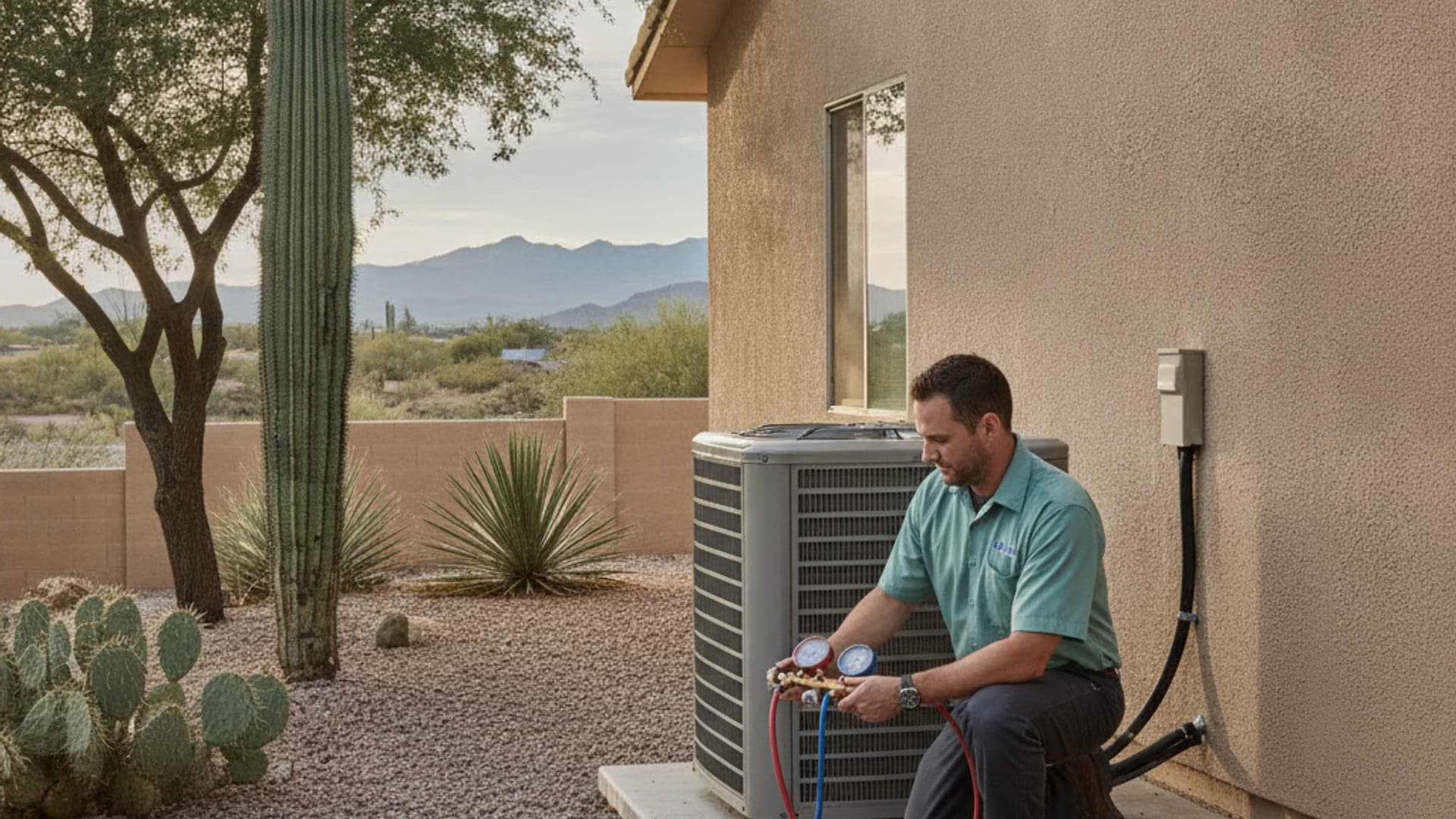
One call gets your request to a licensed pro who covers your part of town. You deal with that company directly, and you hire and pay it yourself.
AC repair and replacement, heat pumps, gas furnaces, mini splits, tune-ups, ductwork, air quality and urgent cooling and heating requests. If you also have a swamp cooler, say so when you call; the matched company confirms whether it works on evaporative coolers.
AC quit in the heat? We match you with a licensed Tucson-area pro for split systems and rooftop package units.
Learn moreNew split systems and rooftop package units, sized with the load calculation the City of Tucson requires.
Learn moreA spring check before the 100F stretch and a fall check after the monsoon dust, from a licensed pro.
Learn moreNo heat on the first cold night? The pros we send work on gas furnaces, gas packs and electric heat.
Learn moreSplit and rooftop heat pumps: repair, replacement and new installs, plus the TEP rebate questions to ask.
Learn moreArizona rooms, casitas, garages and block homes with no ducts, cooled and heated room by room.
Learn moreThermostats wired for your system and set up around TEP time-of-use hours.
Learn moreCleaning when the ducts show real cause, and sealing for leaks in a hot attic or roof run.
Learn moreFiltration and ventilation for monsoon dust, wildfire smoke and pollen, matched to what your system can move.
Learn moreCoils, capacitor, drain and airflow checked before the heat, with TEP tune-up rebate questions answered.
Learn moreRestaurants, offices and retail. Rooftop units and split systems on Tucson-area buildings.
Learn moreNo cooling in a Tucson summer is a health problem. We pass the call on; the matched pro confirms whether it can come.
Learn moreLong, very hot summers, a humid monsoon and short, mild winters. Tucson International Airport averages about 2.6 cooling degree days for every heating degree day (1991-2020 normals), so an air conditioner here does most of the year's work.
Long run cycles in the heat are hard on the outdoor unit's electrical parts. The usual failures are a capacitor or contactor, a condenser fan motor, a refrigerant leak, or a coil that freezes when a dusty filter starves it of air. The City of Tucson sizes equipment for a 105F summer design temperature, so on a 110F day even a healthy system may run nonstop. Our AC repair page walks through the checks to make before you call.
A Tucson home can have either one. A package unit holds everything in one cabinet, often on the roof. A split system puts a condenser outside and an air handler or furnace inside. Tell us which you have, because it changes access, the replacement options and the quote.
The National Weather Service's monsoon window runs June 15 through September 30. It brings dust storms, power interruptions and a jump in humidity. Filters and outdoor coils load up with dust, condensate drains work harder, and swamp coolers lose much of their punch once dew points climb. See our swamp cooler vs AC guide for the trade-offs.
In the basin, not much: no normal day at the airport stays below freezing, and the all-time record low is 6F. Mount Lemmon is different. The station near Summerhaven logs about 4,024 heating degree days a year, roughly three times the airport, and about 53 freezing nights. Our furnace repair page covers the first cold night of the season.
For most homes in the Tucson basin, a heat pump is the sensible default. Heating duty is mild, with fewer than 12 freezing nights a year at the airport and a City of Tucson winter design temperature of 35F, and the same unit does the cooling the home needs anyway. On Mount Lemmon and in Summerhaven, a cold-climate heat pump or backup heat is a question for the pro.
Compare options on our heat pump service page and in heat pump vs AC and furnace.
TEP's Efficient Home Program is an instant rebate taken off the price when you hire a participating contractor. As listed by TEP in October 2026: up to $720 for a heat pump quality installation, up to $600 for an AC quality installation, up to $300 for duct sealing, up to $100 per ton for a mini split and up to $160 total for an AC tune-up. It applies when you retire an older working unit or a non-working AC. Amounts change, so confirm with TEP or the contractor at quote time.
On TEP's Time-of-Use plan, summer on-peak runs May to September, Monday to Friday, 3 to 7 p.m. Cooling the house before 3 p.m. and letting it drift during peak moves use out of those hours. If Trico Electric Cooperative sends your bill (parts of northwest Tucson and Marana, south to Green Valley and Sahuarita), check with Trico instead. The federal 25C credit doesn't cover a system installed in 2026, and Arizona has no state HVAC tax credit. Details on our rebates and financing page.
Look the company up with the Arizona Registrar of Contractors at roc.az.gov before anyone starts work. Every pro we send is licensed, and it still takes two minutes to check.
Our guide to checking an Arizona ROC license goes step by step.
Tucson and the communities around it, from Marana and Oro Valley to Vail, Sahuarita and Green Valley. Pick your area for local notes and the services there. The matched company still confirms that it covers your address.
Downtown, the historic barrios, the University area, Midtown and the Northside, plus the City of South Tucson. The oldest housing in the metro, and a large share of renters.
The Westside and Southside, Drexel Heights, Valencia West, Tucson Estates and Summit, on the valley floor west of the Santa Cruz River and south toward the airport.
Picture Rocks, Avra Valley, Three Points and the Tucson Mountains side of Gates Pass: large lots, ranchettes and manufactured homes, and some of the longest drives in the area.
Marana, Continental Ranch, Dove Mountain and Red Rock, plus the older neighborhoods of Casas Adobes and Flowing Wells.
Oro Valley, Rancho Vistoso and Catalina, then north into SaddleBrooke, Oracle and San Manuel, climbing from about 2,700 feet to about 4,500 at Oracle.
The Catalina Foothills and Tanque Verde, and Summerhaven up on Mount Lemmon, where heating matters more than cooling.
The Eastside, Rita Ranch and southeast Tucson, Vail, Rincon Valley and Corona de Tucson.
Sahuarita, Quail Creek, Green Valley and Arivaca Junction along I-19. Trico Electric Cooperative serves parts of this corridor, so check which utility sends your bill.
We match you with a licensed local HVAC pro for your repair or replacement.
A few of the questions people ask before they request a match. Don't see yours? Call us at (520) 353-2520.
All FAQsIt's a trade rule of thumb, not a promise. Multiply the unit's age by the repair quote. If the result tops $5,000, price a replacement next to the repair before you decide. Get both as separate written quotes.
Make sure the thermostat is set to cool and has power, check the breaker and the disconnect by the outdoor unit, and look at the filter. Check whether water is backing up at the indoor unit, since a float switch on the condensate line can shut cooling off. If the outdoor unit hums without starting or a breaker trips again, leave it off and call.
Climate Pros Tucson is a referral service. Call (520) 353-2520 with your address, system and symptoms. The licensed company you are matched with confirms whether it can take the job, when it can come and what it charges. We do not promise an arrival time.
It depends on the size from a load calculation, the equipment, ducts, electrical work, the permit and whether the unit sits on the roof or the ground. The City of Tucson requires a load and sizing calculation for new and replacement equipment. Ask for model numbers, scope, the permit and warranty terms in writing. Climate Pros Tucson does not set contractor prices.
A swamp cooler works best when the air is dry, which describes most of Tucson's year. In July and August, average dew points at the airport jump into the high 50s, and a cooler loses much of its punch. Refrigerated air or a heat pump keeps working through the monsoon.
Yes. The City of Tucson requires permits for new or replacement air conditioners, heat pumps and furnaces, and a load and sizing calculation for that equipment. The licensed contractor you hire pulls the permit.
Plain-language guides and comparisons for Tucson homes. No email required.
A rough starting point for system size. The City of Tucson still requires a real load calculation for new and replacement equipment.
Open the calculator CompareWhen a heat pump makes sense in the Tucson basin, and when a gas furnace or backup heat still does.
Read the comparison CompareThe $5,000 rule of thumb, the refrigerant changeover and what a replacement quote should list.
Read the comparison GuidesCost questions, troubleshooting, swamp coolers, TEP rates and monsoon prep for Tucson homes.
Browse guides FAQStraight answers on repairs, heat pumps, permits, rebates and hiring a licensed contractor.
Read the FAQ ResourcesWalkthroughs for the simple jobs you can handle yourself, like filters and thermostats.
Watch guides