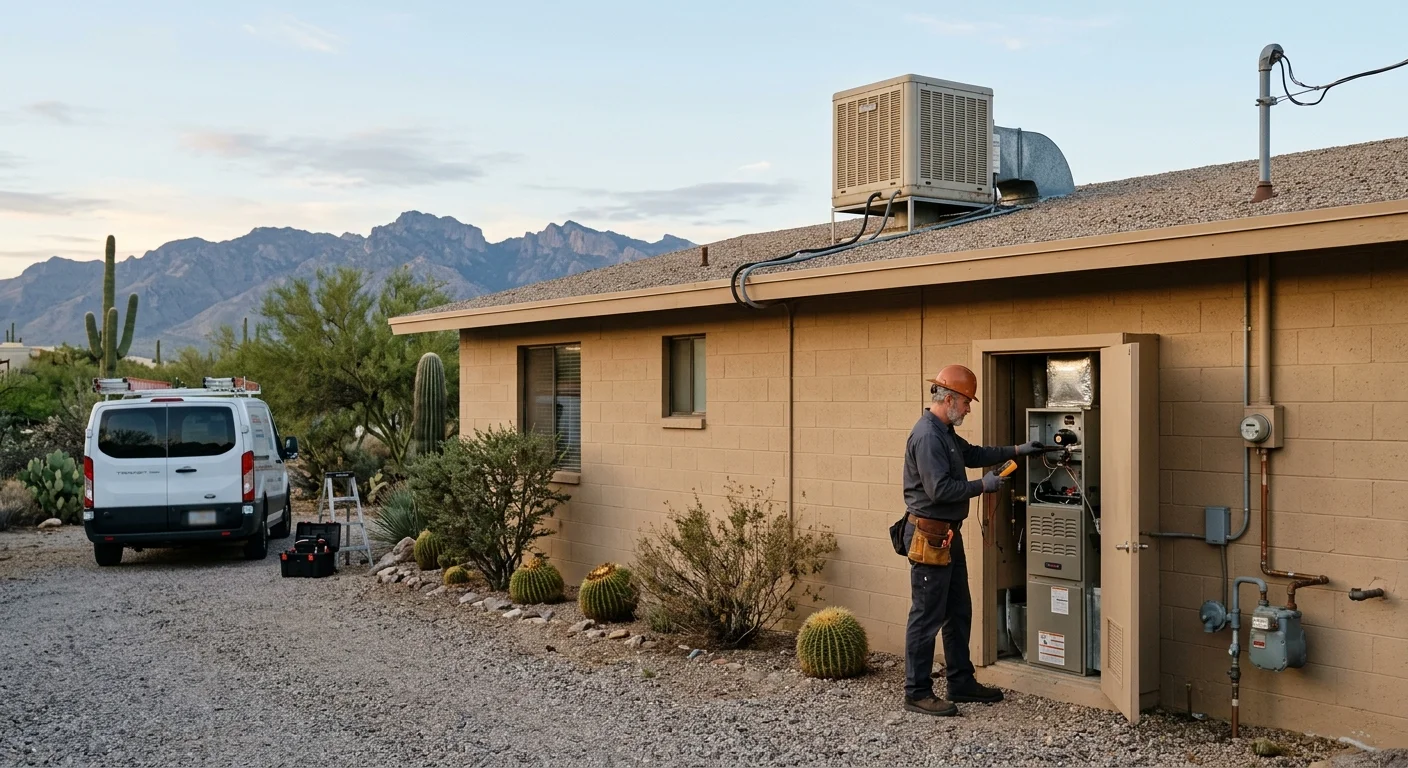
A furnace tune-up before winter in Tucson belongs on the calendar in October. Do it before the first freeze, not after the house goes cold. Climate Pros Tucson matches you with a licensed independent pro who inspects and services the heating side. Check National Weather Service Tucson for the freeze forecast. A blog cannot pick that night for you.
Cooling season is ending. The official monsoon window runs June 15 through September 30. At Tucson International Airport, the 1991-2020 October normal is 86.3F by day and 59.0F by night. December’s normal low is 40.5F, with 372.9 heating degree days. The heating plant sat idle through about 68 days at or above 100F. The first real heat call is the test.
What does a heating-season tune-up actually cover?
It is a safety and operation check on equipment that has been off for months. The pros we send for HVAC maintenance walk the heating path, not a marketing checklist with a made-up point count.
On a gas furnace, that usually means:
- Confirm the thermostat is in heat and the setpoint is above room temperature
- Check the filter and the blower compartment
- Watch ignition, flame, and shutdown
- Inspect visible venting and the heat exchanger
- Look at condensate handling on a high-efficiency unit
- Run a heat cycle and confirm warm air at the registers
On a heat pump, the same visit should confirm the unit actually reverses into heat. Aux heat is a question for the pro, not a default in the Tucson basin. A heat pump is the sensible default here: mild heating duty, and the same unit already does the cooling. City of Tucson energy code is climate zone 2B, with a 35F winter design dry bulb. Mount Lemmon and Summerhaven are the exception.
If the pro finds a no-heat fault, the visit turns into furnace repair. Ask for that finding in writing before any parts come off the shelf.
EPA does not recommend routine duct cleaning on a fixed schedule. Clean ducts when there is substantial visible mold, vermin, excessive dust, or debris blowing from registers. ENERGY STAR notes a typical forced-air house can lose about 20% to 30% of the air moving through ducts to leaks. That is a national typical-house statement, not a measured Tucson result. Sealing addresses leakage. Cleaning alone has little evidence for efficiency or health.
Why is Tucson’s first cold night a hard test?
Tucson’s heating season is short, sharp, and easy to ignore. 1991-2020 normals at Tucson International Airport show fewer than 12 nights at or below 32F. No normal day stays below freezing. Annual snowfall is 0.1 in. The basin logs 1,333 heating degree days and 3,424 cooling degree days, about 2.6 cooling degree days for every heating degree day. The furnace or heat pump spends most of the year idle, then has to fire near the city’s 35F winter design on the first hard night.
That is why a planned tune-up beats a panic call. The first cold night furnace pattern is simple: ignition that sat all summer, a damper left open, a filter packed with monsoon dust, or a thermostat still in cool.
The basin is not one climate. Oro Valley and Marana sit on the northwest side, where Trico Electric Cooperative serves many homes from northwest Tucson and Marana south to Green Valley and Sahuarita. TEP serves the Tucson metropolitan area, including much of the east side and Vail. If you are on TEP time-of-use, winter on-peak is October to April, Monday to Friday, 6 to 9 a.m. and 6 to 9 p.m. Electric heat in those windows hits the peak. A gas furnace on Southwest Gas does not.
Mount Lemmon and Summerhaven are a different heating job. At the Mount Lemmon station, January normals are 49.6F high and 33.5F low. There are about 53 nights a year at or below 32F, and about 4,024 heating degree days, about three times the airport. Pima County treats elevations above 4,000 feet as zone 5B, with a 4F winter design dry bulb. Backup heat there is a question for the pro, not a basin default.
Statewide, EIA’s 2020 survey found 55% of Arizona homes using a central furnace as main heat and 25% using a central heat pump. Those are Arizona figures, not Tucson counts. Electricity was the main heating fuel in 51% of Arizona homes, natural gas in 36%.
What about swamp cooler dampers, filters, and the heat switch?
An open cooler damper can dump heated air straight out of the house. If you still have a swamp cooler (an evaporative cooler), treat the damper and the winter cover as part of the heating-season checklist. The steps live on our swamp cooler winterize page. Do not skip that visit and then blame the furnace.
Filters matter here because monsoon dust does not wait for winter. Change a packed filter before you ask the blower to push heat. Keep supply and return registers open. Furniture on a return in a slump-block hallway will starve the same furnace the pro just checked.
Then switch the thermostat to heat on a cool October morning. Raise the setpoint a few degrees and wait for the cycle. You want warm air at the vent, a normal sound, and a clean shutdown. If you get nothing, or you get air that stays cold, stop and call for a licensed pro. The rest of the fall HVAC checklist covers the cooling shutdown that should already be done.
Tucson Water notes that hard water builds calcium deposits in evaporative coolers, water heaters, and dishwashers. It advises changing swamp cooler pads regularly and adding an in-line filter. That is a cooler issue, and it still belongs on a heating-season walkthrough if the damper shares the duct path.
What should you ask a licensed pro before they leave?
Ask for findings in plain language, then get them on the written quote. Climate Pros Tucson is a referral service. You contract with the independent licensed contractor, and you pay that contractor.
Questions worth asking:
- Did the heat exchanger look intact, and did you see the flame?
- Did it ignite and shut down cleanly?
- What did you find on the filter, blower, and visible ducts?
- Is the swamp cooler damper closed so heat is not leaving through the roof?
- For a heat pump, did it reverse into heat, and did aux heat stay off unless needed?
- What, if anything, should be repaired before the first freeze?
- What is your diagnostic fee, and does it apply toward a repair? Each company sets its own policy.
Check the contractor’s license yourself at the Arizona Registrar of Contractors, roc.az.gov. Residential heating and cooling is class R-39 or its R-39R subclasses. Every pro we send is licensed. The brand holds no ROC license and does not pull permits.
If the finding is a replacement, the matched contractor pulls the permit. In the City of Tucson, new or replacement furnaces, heat pumps, and air conditioners need a permit, and load and sizing calculations are required. See the City of Tucson residential permits page. Do not assume a tune-up is the same job as a changeout. Towns set their own fees. Confirm the rule for your address with the contractor and the building department.
If you smell gas, leave the house. Call Southwest Gas or 911. Do not open the furnace to hunt for a leak.
Arizona landlords must supply reasonable heat and keep HVAC facilities in good and safe working order. Renters can use that standard when the heat fails.
How does this visit tie to a later repair or replace call?
A tune-up is how you learn whether the unit should be left alone, repaired, or replaced, while you still have mild afternoons. A cracked heat exchanger, a dead inducer, or a blower that will not start is no longer maintenance. It is a repair-or-replace decision.
Trade people sometimes use the 5,000 rule as a rule of thumb on that math. It is not a brand promise and it is not a Tucson price. Work it with the numbers on your written quotes. The walkthrough is in our 5,000 rule piece.
Southwest Gas’s 2026 Arizona residential rebate application lists low-flow showerheads, clothes washers, and windows. No furnace rebate appears on it. The federal 25C credit ended for equipment placed in service after December 31, 2025. A furnace installed in 2026 does not qualify. TEP’s Efficient Home Program is still active through participating contractors, with amounts as listed by TEP in October 2026, but it is built around heat pumps, AC quality installation, duct sealing, mini splits, and AC tune-ups. Confirm current terms with TEP at quote time.
If you are replacing heat in the basin, ask the pro whether a heat pump fits the house. That is the sensible default here. On Mount Lemmon, ask about cold-climate equipment or backup heat.
Common questions
Does it snow in Tucson, Arizona?
Barely, in the basin. The 1991-2020 snowfall normal at Tucson International Airport is 0.1 in. The first freeze is an overnight temperature drop, not a snow event. Summerhaven is the place with a real heating season.
Do heat pumps need a winter tune-up too?
Yes. If the home heats with a heat pump, the October visit should confirm it reverses into heat. Tucson-basin heating duty is mild. The failure mode is still the first cold night after a long off season.
What is the 5,000 rule?
It is a trade rule of thumb for repair versus replace, not a quote from Climate Pros Tucson. Use the arithmetic on your own written numbers. Do not treat it as a Tucson market price. Those have not been published from a sourced local survey.
How do I check that the pro is licensed?
Look the license up at roc.az.gov. You want R-39 or a fitting R-39R subclass for residential heating and cooling. Handyman work under $1,000 does not cover a City of Tucson HVAC replacement, because that replacement needs a permit.
When to call us
Call when you want a licensed pro to inspect and service the heat before Tucson’s first freeze, or when a heat cycle already failed. Call (520) 353-2520 and we’ll match you with a licensed local pro.