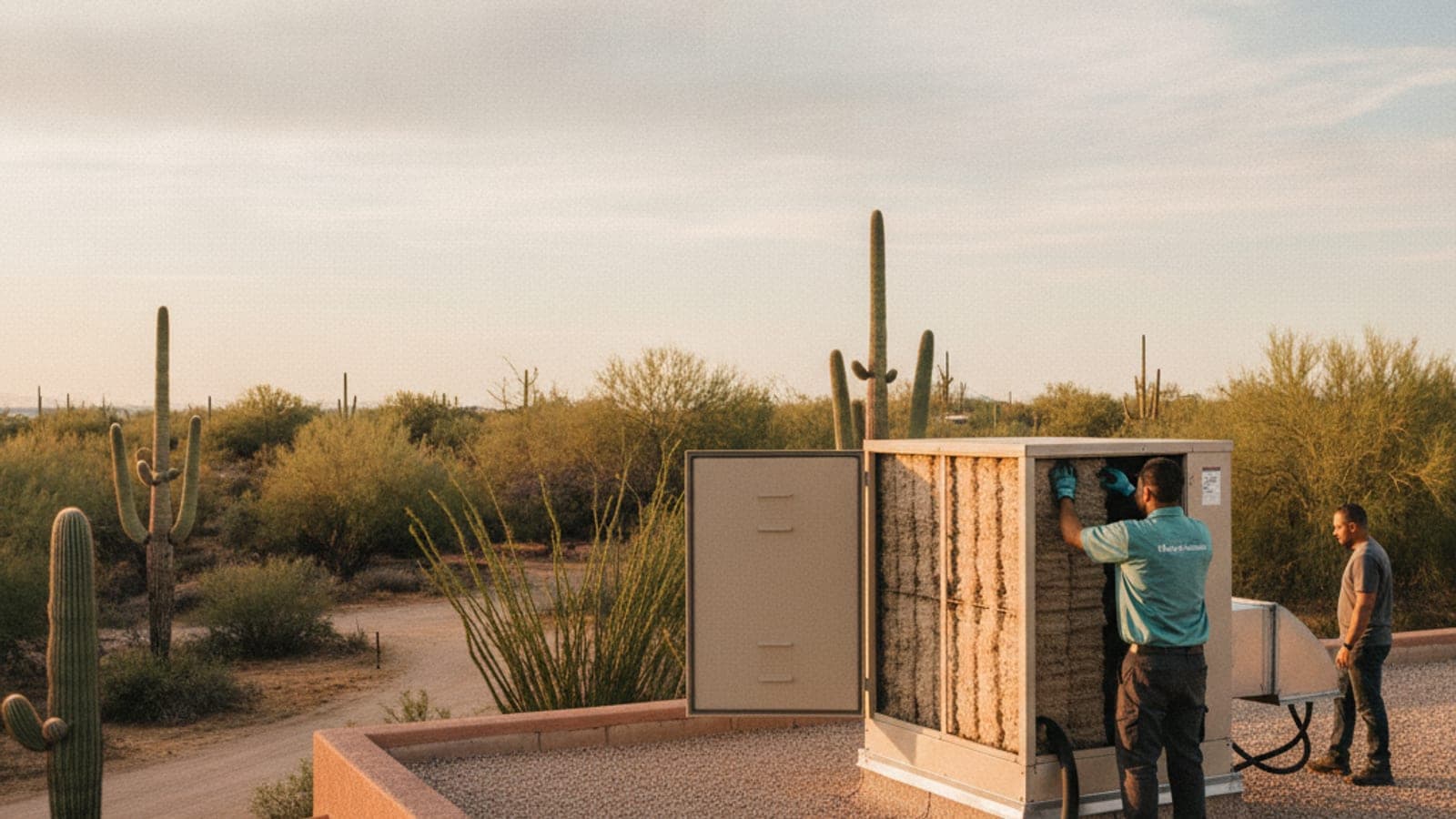
Rigid media pads (the thick, corrugated cellulose or plastic kind) generally hold up to scale better than aspen pads, while aspen pads cost less up front and are easy to swap. In Tucson, the water matters more than the pad type. Tucson Water says hard water builds calcium deposits in evaporative coolers and advises changing the pads regularly and adding an in-line filter.
Climate Pros Tucson matches homeowners with licensed HVAC pros and doesn’t sell pads. The pad your cooler takes, and the schedule that suits it, are in the manufacturer’s manual.
Why does hard water matter so much for cooler pads?
A cooler cools by pulling air across wet pads. The water that evaporates leaves its minerals behind. Tucson Water explains that the area’s groundwater is hard, and that mixing it with Central Arizona Project water is part of why. The result is a crust of calcium on the pads, the pan and the pump.
Scale does two things. It blocks airflow through the pad, so the cooler moves less air. It also sheds flakes and builds up in the pan, which stresses the pump and the float valve. Tucson Water’s own advice is the practical part: change pads regularly and add an in-line filter.
Aspen vs rigid media: how do they compare?
| Aspen pads | Rigid media pads | |
|---|---|---|
| What they are | Loose wood shavings held in a frame | Rigid corrugated sheets, thick and stacked |
| Up-front cost | Lower | Higher |
| Scale behavior | Clog as minerals fill the gaps, then need replacing | The channels are wider and the sheets can be rinsed, so they tend to last longer |
| Smell | Can turn musty or woody when old or kept damp | Less prone to a wood smell |
| Fit | Fits many older coolers | Needs a cooler built or adapted for it |
| Maintenance | Swap the whole pad | Rinse and inspect, replace when the surface is crusted or soft |
Pad life and cost per season depend on the brand, the cooler, your water and how hard you run it. Go by the pad maker’s guidance and the warning signs below, not a fixed number of months.
Which one should you pick?
Start with what the cooler was built for. A rigid media cooler needs the matching media and frame. An aspen cooler usually can’t take rigid media without changes to the pad frame and the water distribution.
If your cooler takes either, ask yourself how much you want to handle each year. Aspen is cheap and forgiving, but expect to replace it. Rigid media costs more once and asks for rinsing and checking. Either way, hard water decides how long it lasts.
When should you change pads mid-summer?
Don’t wait for a calendar date. Change or rinse them when you see:
- A white or tan crust on the surface that doesn’t rinse off.
- Weak airflow at the vents, even with the pump running.
- A musty, sour or wet-wood smell from the supply air.
- Dry patches where water no longer wets the pad.
- Pads that look matted, sagging or broken down.
The dry stretch from spring into early summer is when a cooler does its best work and evaporates the most water, so check the pads in June before the monsoon. After that, weak cooling has a different cause: a fresh pad won’t fix a humid night. Why your swamp cooler quits in the monsoon covers that side.
How do you cut down on scale and smell?
- Add an in-line filter, as Tucson Water advises.
- Shut the water off and let the pads dry out before shutting the cooler down for the season, so they don’t sit wet.
- Drain and clean the pan so mineral sludge doesn’t build up.
- Use the pump, float and bleed-off settings the manual calls for.
- Keep the cooler’s pad frames and distribution lines clean, since a clogged line leaves dry spots.
When pads aren’t the fix
Pad swaps are within reach for many homeowners with a manual in hand. If the cooler leaks, the pump is dead, or you’re weighing a switch to refrigerated air, you need a licensed pro. Our matched pros handle AC repair and AC installation, and some can talk through a switch. Whether a particular pro services evaporative coolers is something to ask when you call. See the full Tucson HVAC service area.
Call (520) 353-2520 and we’ll match you with a licensed local pro.