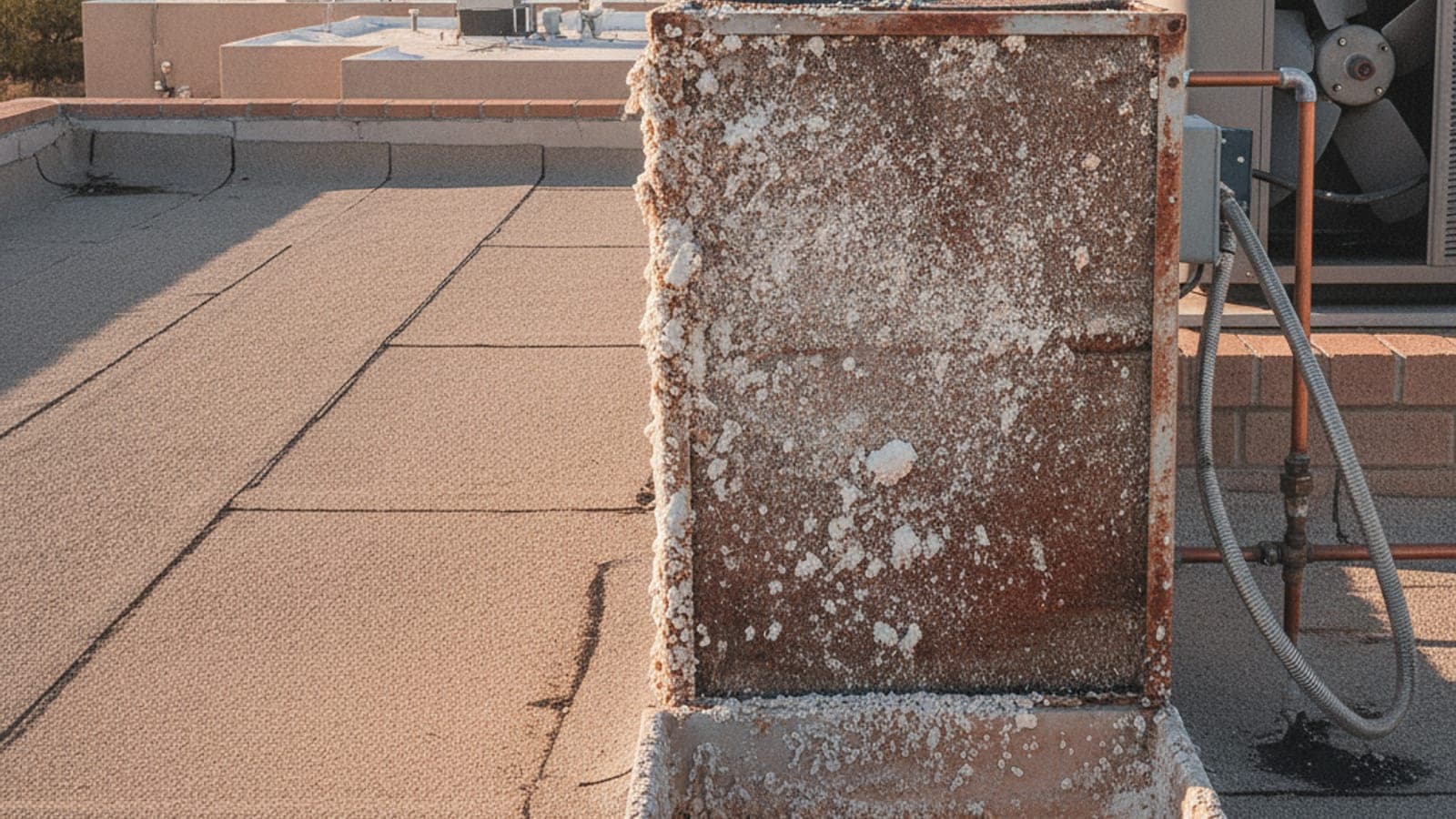
A bleed-off kit slows scale by draining a little of the cooler’s water all the time, so minerals can’t pile up, and the price is more water use. A regular pump-down does the same job by hand. Climate Pros Tucson matches you with a licensed pro if the cooler needs more than that.
Why does hard water scale up a swamp cooler?
Evaporation leaves minerals behind. Water evaporates off the pads to cool the air, and the calcium stays in the pan and in the pads. Tucson Water says hard water builds calcium deposits in evaporative coolers, water heaters and dishwashers, and that Tucson’s water is hard because local groundwater is mixed with Central Arizona Project (CAP) water. It advises changing swamp cooler pads regularly and adding an in-line filter.
Scale stiffens and blocks the pads, crusts the float and pump, and narrows the water lines. Crusted pads pass less air and wet unevenly, so the cooler cools less.
What does a bleed-off kit do?
A bleed-off kit sends a small amount of the pan’s water to a drain, either steadily or on a cycle, so the minerals don’t keep concentrating. Fresh water replaces it. The scale builds slower, and pads last longer. The tradeoff is water: you use more of it than a cooler that only tops off what evaporates. Ask for the kit’s drain rate from the manual and where the drain water will go, since it shouldn’t run against a wall or onto a roof surface that can pond.
Is a pump-down or drain enough?
It can be, if you keep to it. Draining and flushing the pan on a schedule keeps minerals from building up, with no extra water use between flushes. It costs time instead, and it depends on you remembering. A bleed-off kit does the same work without you. Neither replaces pad changes, and neither stops scale completely.
Which should you choose?
| Option | Water use | Your effort | Best when |
|---|---|---|---|
| Bleed-off kit | Higher, steady | Low | You want less scale with little attention |
| Scheduled pump-down | Lower between flushes | Higher | You’ll do the maintenance and want to save water |
| Pads and in-line filter only | Lowest | Moderate | The cooler is lightly used |
The kit and its fitting are priced by whoever installs it, so ask for both as dollar figures.
Does scale explain weak cooling in July?
Not always. Evaporative cooling depends on dry air, and at Tucson’s airport average dew points sit in the 20s most of the year and jump into the high 50s in July and August. A clean cooler fades then too. If the pads are wet and evenly soaked, scale isn’t the main problem. See why a swamp cooler quits in the monsoon.
When to call us
If the cooler is scaled past saving, or you’re weighing a switch to refrigerated air, call (520) 353-2520 and we’ll match you with a licensed local pro. Ask up front whether the pro works on evaporative coolers; on roc.az.gov, the R-39 class and the R-39R evaporative cooling subclasses cover that work. See swamp cooler vs AC, pads: aspen vs rigid media, winterizing a cooler and the Tucson hub.