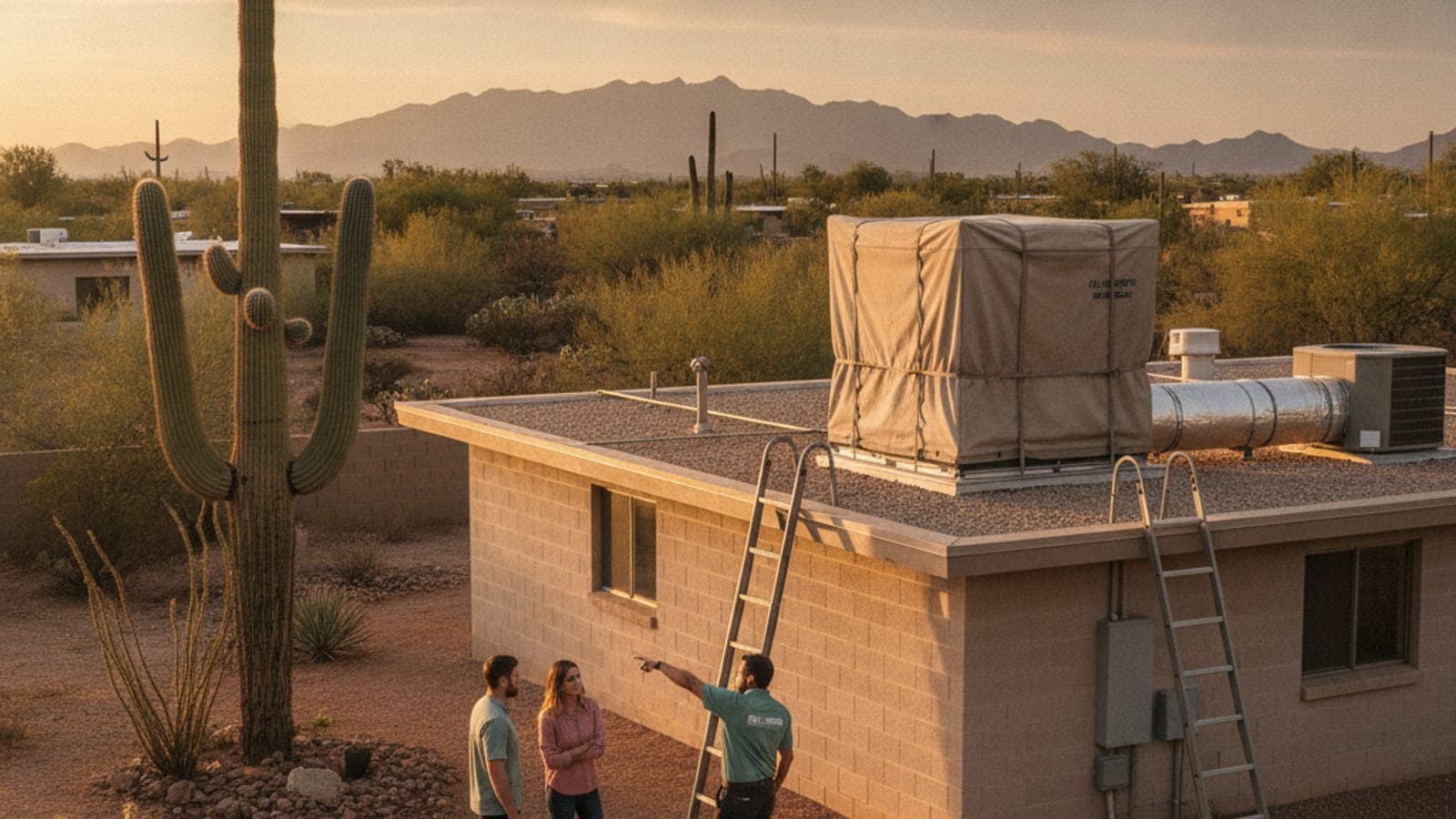
What does winterizing a swamp cooler involve?
Four jobs: shut off power and water, drain and clean the cooler, cover the outside, and seal the opening inside. Do them before the first night that might reach freezing, because water left in the line or pan can freeze and crack fittings. Follow your model’s manual where it differs from this list. Climate Pros Tucson can match you with a licensed pro if you’d rather not do it yourself.
When does Tucson freeze?
Only a few nights a year, but every year from 2016 through 2025 had at least three. At Tucson International Airport the 1991-2020 normals show fewer than 12 nights a year at or below 32F, and no normal day stays below freezing. The count swings a lot: the airport logged 3 freezing nights in 2021 and 17 in 2019. Monthly normal lows bottom out at 40.5F in December and 40.8F in January, so a freeze arrives as a cold snap, not a season. The cooler’s done its job by then anyway: November’s normal high is 75.1F. Watch the NWS Tucson forecast from November on rather than trusting a calendar date.
Up at Mount Lemmon and Summerhaven, the normals show about 53 freezing nights a year, so winterize much earlier there.
How do you winterize it, step by step?
- Turn the cooler off at its switch, then at the breaker or disconnect, before you touch the pump.
- Shut the water supply to the cooler and open the line to drain it.
- Drain the pan or sump, and clean out the scale and debris. Let it dry.
- Remove the pads or let them dry out, and check them. Tucson Water advises changing swamp cooler pads regularly, since hard water leaves calcium deposits.
- Wrap or cover the exterior with a fitted cover so cold air and dust stay out.
- Close the damper or fit a winter cover on the inside opening, so the cold air coming off the roof doesn’t flow into the house.
The damper step matters most for comfort. An open cooler duct acts like a hole in the ceiling all winter.
Should you go on the roof yourself?
Only if you’re steady on a ladder and the roof is dry. A roof-mounted cooler means working near an edge, and a fall is the real risk in this job. If you don’t feel sure, call a pro rather than climbing. Ask whether the pro works on coolers, since some companies do and some don’t; the R-39 class and the R-39R evaporative cooling subclasses on roc.az.gov cover that work.
What about spring?
Reverse it in April, before May’s normal highs reach the low 90s. The full list is in the spring start-up checklist. If you’re weighing a switch to refrigerated air, see swamp cooler vs AC in Tucson.
If you’d rather not climb
If you’d rather move to refrigerated air than keep winterizing a cooler, or you want to ask what a pro can help with on your setup, call (520) 353-2520 and we’ll match you with a licensed local pro. See AC installation or the Tucson hub.