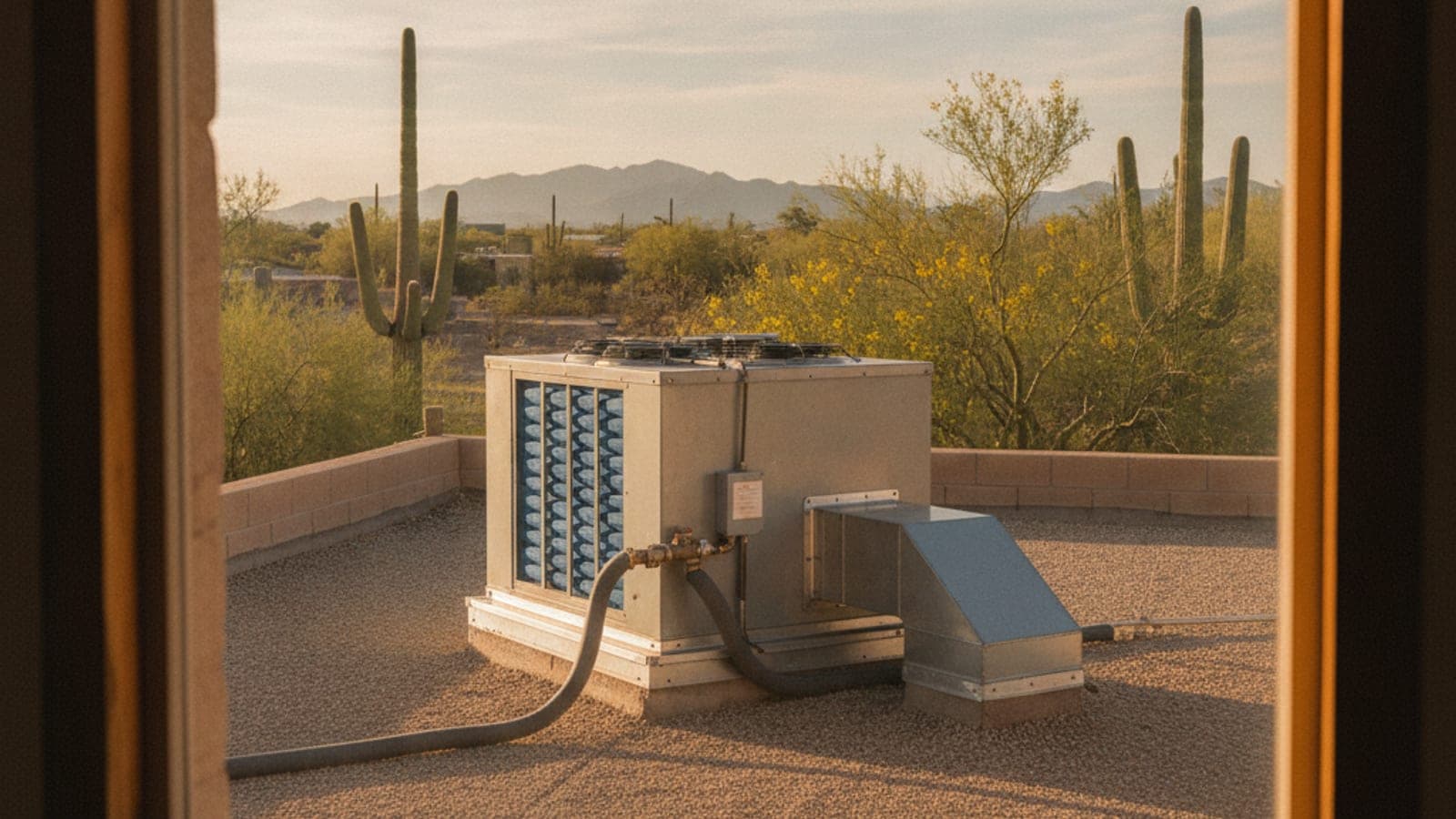
Start the cooler in April, before the first run of 90-degree days, not during it. Do the checks below with the power off, run it for a test, and hand off anything that means electrical repair or roof work you’re not steady doing. Climate Pros Tucson can match you with a licensed pro for those.
When should you start a Tucson swamp cooler?
In April. The normal high at Tucson International Airport is 82.9F in April and 91.8F in May (1991-2020 normals), so April is the last month a cooler problem isn’t urgent. Average dew points at the airport sit in the 20s for most of the year, and that dry air is when a cooler does its best work. A test run in April leaves time to order a pump or pads before May. The monsoon runs June 15 through September 30, and dew points jump into the high 50s in July and August, so a cooler has less to give then. See swamp cooler vs AC.
What should you check before turning it on?
Work through these in order. Your manufacturer’s manual outranks any list, this one included.
- Power off. Switch off the cooler’s breaker or disconnect before you open any panel.
- Water line. Reconnect or open the supply that was shut off for the cold months. Look for cracked fittings.
- Pads. Look for crumbling, caked mineral scale or sour smell. Tucson Water says hard water leaves calcium deposits in evaporative coolers and advises changing pads regularly and adding an in-line filter.
- Pan and pump. Clear debris and scale from the water pan. Confirm the pump sits in water and its screen isn’t clogged.
- Float valve. It should shut the water off at the right level. Stuck open means overflow, stuck closed means a dry pump.
- Distribution lines. Water should reach the top of every pad evenly.
- Belt. Look for cracks and glazing, and check tension per the manual. More in motor and belt problems.
- Bearings and motor. Spin the blower by hand. It should turn freely and quietly.
- Damper or inside cover. Open the damper or pull the winter cover you fitted in fall, or the cooler will push air into a sealed duct. The fall steps are in winterizing a swamp cooler.
How do you run the first test?
Open a window or two in the house so air has somewhere to go. Turn the power back on, run the fan alone first, then add the pump. Watch for dripping, odd noise and uneven wetting. Let it run a while and feel the air at the vents.
Is it safe to do this yourself on the roof?
Roof work is the real hazard. Ladders shift, and a roof wet from the test run slips. Spring is the easier time to do it, before the roof surface gets hot. If you can’t do the checks safely, skip them and ask the pro how they handle roof access and what the visit covers.
What if the cooler is past saving?
If pads, pump and frame keep failing, a swap or a switch to refrigerated air may make more sense. A permit is listed in the City of Tucson for new evaporative coolers only, and for new or replacement air conditioners and heat pumps. When you call, ask whether the pro works on evaporative coolers. On roc.az.gov, cooler work falls under the R-39 class or an R-39R evaporative cooling subclass. Related: why a swamp cooler smells, a heat pump or AC conversion, and AC installation. The Tucson HVAC hub lists where we cover.
When to call us
If the cooler needs more than a spring cleanup, or you’re thinking about moving to refrigerated air, call (520) 353-2520 and we’ll match you with a licensed local pro.