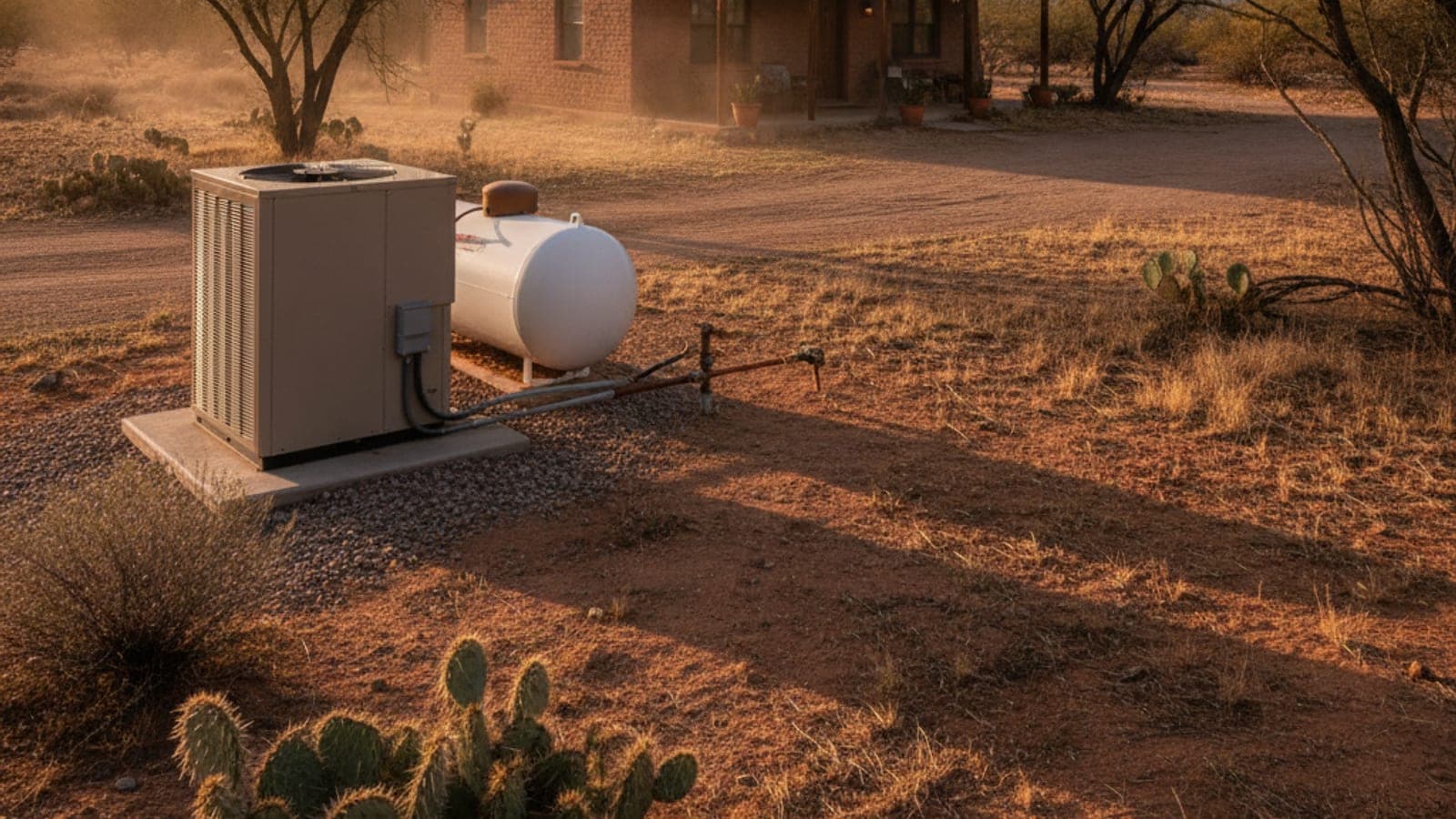
What changes about HVAC outside the city?
A few practical things change: who supplies your power, what fuel you heat with, which permit rules apply, and how far a pro has to drive. The equipment is the same. The details around it aren’t. If you live in Picture Rocks, Three Points, Avra Valley, Corona de Tucson or Vail, plan for those four questions before you hire anyone. Avra Valley sits at about 1,950 feet, lower than the city core, and Picture Rocks spreads across about 71 square miles, so heat load and drive time both count.
Climate Pros Tucson matches you with licensed local pros, and those pros confirm what applies to your address.
Who supplies your power?
TEP serves most of the Tucson metro. Trico Electric Cooperative, a non-profit co-op, serves northwest Tucson and Marana south to Green Valley and Sahuarita. That matters because rebates are tied to the utility. TEP’s Efficient Home Program is a TEP program. If Trico is your utility, ask Trico what it offers.
What about heating fuel?
Gas lines don’t reach every rural address, so some homes heat with propane or electricity instead. Statewide, EIA reports electricity as the main heating fuel for 51% of Arizona homes, natural gas for 36% and propane for 2% (2020). Those are Arizona figures, not Pima County ones.
If you’re on propane, a heat pump can be worth comparing with a propane furnace. Heating duty in the Tucson basin is mild, with fewer than 12 nights a year at or below 32F at the airport. Read heat pump vs gas furnace in Tucson and dual-fuel heat pumps.
Higher ground is different. Above 4,000 feet, Pima County’s code uses climate zone 5B with a winter design temperature of 4F. See HVAC on Mount Lemmon and Summerhaven.
What about permits?
The City of Tucson requires permits for new and replacement furnaces, heat pumps and air conditioners. Rules for unincorporated Pima County addresses can differ. Ask the pro which office issues the permit for your address. The contractor pulls it. If Pima County Development Services issues it, the county’s fee schedule effective July 1, 2026 lists a $69 base fee for permits that need an inspection and $27 for minor mechanical work such as a residential air conditioner unit, as separate line items (checked October 2026). Ask the pro to show the permit fee as its own line on the written quote.
What about well pumps and power?
If your home runs on a well, the pump shares your electrical system. Ask a pro to look at the panel and circuits if you’re adding a heat pump or a mini split. See heat pump and a 100-amp panel.
How do you find a pro who comes out to you?
Ask every contractor up front if your address is in their service area, if there is a trip charge, and how they handle scheduling in peak summer. Get any fee as a dollar figure. Our guide to choosing an HVAC contractor lists what to check, including the ROC license lookup at roc.az.gov.
What if you have a manufactured home?
Manufactured homes are a real share of Pima County housing, about 8.9% of units (ACS 2024). Equipment, ducts and clearances differ. See manufactured home HVAC in Tucson.
Where else do we cover?
See HVAC in Oro Valley and Marana, Sahuarita and Green Valley and East Tucson and Vail. For services, see AC repair and heat pump service. The Tucson HVAC hub has the full list.
When to call us
If you’re outside the city and need a pro who works your area, call (520) 353-2520 and we’ll match you with a licensed local pro.