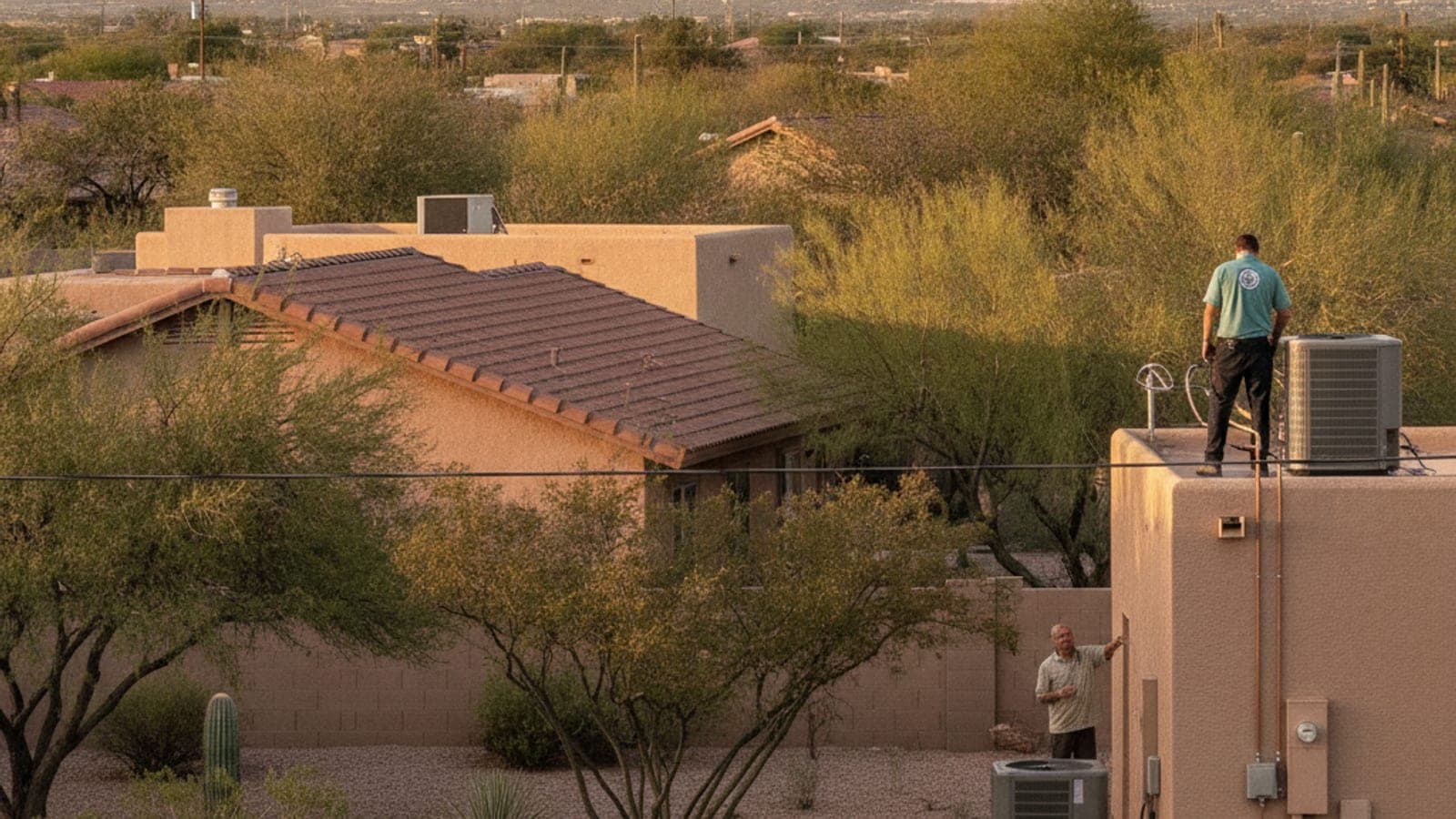
Tucson’s east side and the southeast communities of Rita Ranch and Vail each have a different mix of housing ages, so the equipment tends to differ too. Older Eastside tracts are more likely to have aging systems, and newer subdivisions further southeast are more likely to have younger ones. A licensed pro should check the actual unit at your address.
Climate Pros Tucson matches homeowners in these areas with licensed local pros.
What is different about East Tucson?
The Eastside runs from about Swan Road out toward the Rincon Mountains. Pima County plat records for the area run from 1946 to 2023, with a median recording year of 1975, so much of the housing is 1960s and 1970s single-story tracts, with townhouses, apartments and newer infill near Bear Canyon. Older homes can have older systems, ducts that have aged and, in some, rooftop package units. Those are possibilities to check, not a rule for every house. Our rooftop vs split guide covers the equipment types.
What about Rita Ranch and the southeast?
Rita Ranch, Civano and the surrounding southeast growth area have plats recorded between 1960 and 2025, with a median recording year of 1996. Homes there skew newer than the Eastside’s, so their systems tend to be younger, though a system installed at construction can now be reaching an age where repair or replacement comes up. See repair or replace your AC.
What about Vail and Corona de Tucson?
Vail’s median year built is 2007 and 91.1% of homes are owner-occupied (Census ACS 2020-2024), and half its plats were recorded after 2003. Corona de Tucson, just southeast off SR-83, also has a 2007 median year built, with large 2000s plats such as Sycamore Canyon and Santa Rita Ranch. Both sit about 3,340 feet up, roughly 600 to 900 feet above central Tucson. Heat is still the main load, and a system from the 2000s building wave is now old enough that repair or replacement questions come up. Vail and other communities past city limits are unincorporated, so ask the pro which office handles permits at your address. In the City of Tucson, permits are listed for new or replacement air conditioners and heat pumps, and the contractor pulls them.
What should an east-side homeowner do before summer?
- Change filters regularly. Dust is a constant in the desert.
- Keep the outdoor unit clear of leaves and mesquite debris.
- Have the coil and refrigerant charge checked before the hot season. See pre-summer AC tune-up.
- Ask about a heat pump when replacing equipment. A heat pump is the sensible default for a Tucson-basin home.
Are rebates available?
TEP serves most of the Tucson metro. Its Efficient Home Program works through participating contractors, and listed amounts include up to $720 for a heat pump quality installation as of October 2026. Trico Electric Cooperative serves northwest Tucson and the area from Marana south to Green Valley and Sahuarita. If Trico is your utility, ask Trico directly about any HVAC program.
Who services these areas?
The pros we send cover the Tucson area, including the east and southeast. See AC repair and heat pump service, plus the Tucson HVAC hub and HVAC in Sahuarita and Green Valley.
When to call us
Call when your system is aging, failing or due for a check before summer. Call (520) 353-2520 and we’ll match you with a licensed local pro.