Why do AC capacitors fail in Tucson summers?
Heat and hours. A capacitor is the small can that gives the compressor and fan motors their starting and running boost, and heat wears it down. A Tucson summer runs the system long and hot, and gives it little cool-down at night. Climate Pros Tucson matches you with a licensed pro who can test the part when it goes. This page is about why it fails and what you can do to slow that down. For the symptoms and the questions to ask before you approve a swap, see AC capacitor replacement in Tucson.
How hard does a Tucson summer work the part?
Harder in some years than others. Tucson International Airport averages about 68 days a year at or above 100F (1991-2020 normals), and the July normal low is 76.3F, so the unit keeps starting after dark. The swing between years is large. The airport logged 61 days at or above 100F in 2016 and 112 in 2024, and 18 days at or above 110F in 2023 against 2 in 2022. A summer like 2023 puts far more hot starts on the same part.
What heat does inside the condenser
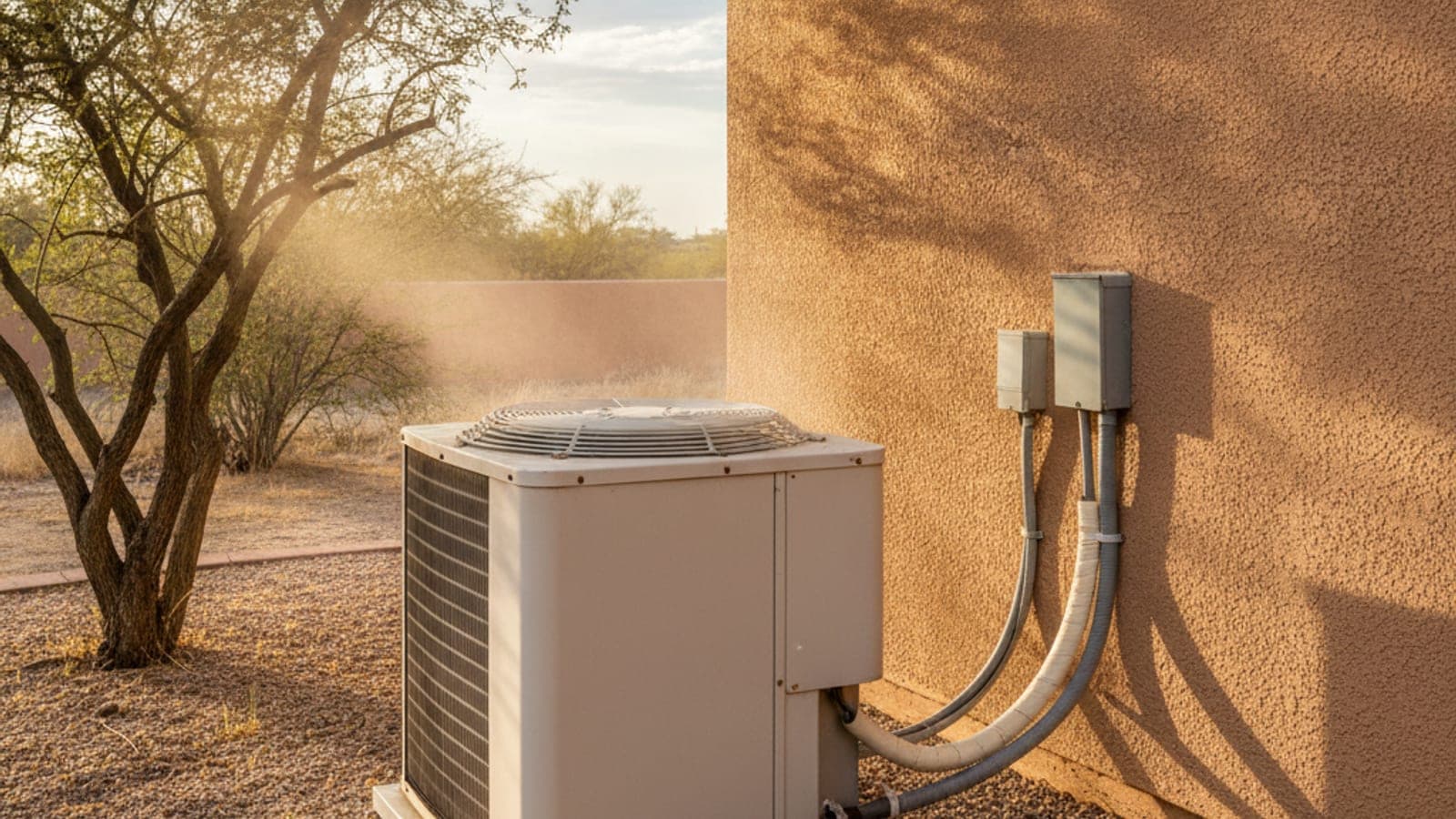
The capacitor sits inside the outdoor cabinet, next to the compressor and fan motor, which shed heat of their own. Afternoon sun on the cabinet adds more. Months of that heat age the part. It slowly loses capacity until one start doesn’t happen.
Two other things add stress. A fan motor with a worn bearing or a dust-packed coil draws more current and runs longer. And monsoon storms, which run June 15 through September 30, bring lightning and strong winds that can knock the power off and on. Our page on monsoon lightning and power flickers covers that side.
What can you do to make one last longer?
You can’t stop the heat, but you can cut the extra load.
- Keep the coil clean. A dusty coil sheds heat poorly, so the unit runs longer per cycle. See cleaning the condenser coil after monsoon.
- Shade without smothering. Shade over the unit helps, but plants or walls close to the sides block the airflow it needs.
- Turn the thermostat off during storm flickers, then restart once power is steady.
- Ask about the fan motor at every tune-up. A motor that’s dragging will take a new capacitor down with it.
What does a failing capacitor look like?
The classic pattern is a hum with no start. The outdoor unit buzzes, the fan doesn’t turn, and the house warms. A dual capacitor serves both the compressor and the fan, so the symptom depends on which side weakened. That’s why a pro tests it with a meter instead of guessing.
Don’t open the panel to look for a swollen top. A capacitor can hold a charge after the power is off. Set the thermostat to off so the unit stops trying to start, and see why the fan isn’t spinning for the look-alike faults.
Is a dead capacitor a sign of a bigger problem?
Sometimes. On its own it’s a small part. But if a replacement dies within the same summer, or the compressor labors to start, ask the pro to check the motor and contactor and explain what else is wearing. A hard-start kit is sometimes suggested for an older compressor, and that post covers when it helps and when it only hides a problem.
Getting a humming unit tested
A humming outdoor unit in July isn’t a wait-and-see problem. Call (520) 353-2520 and we’ll match you with a licensed local pro. Start with AC repair or the Tucson hub.