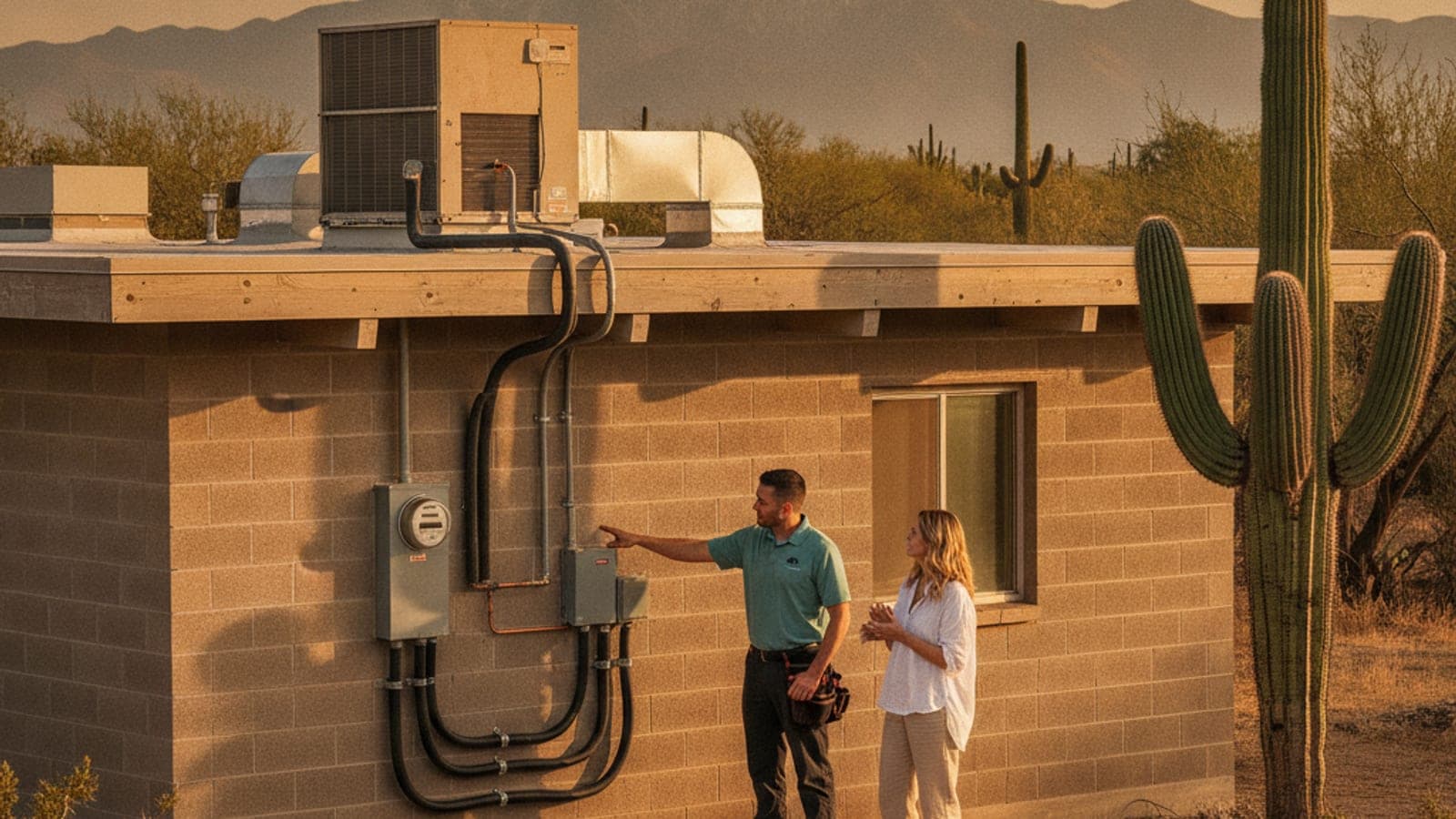
Why does a slump block or adobe home stay hot after sunset?
Heavy walls store heat. Block and adobe soak up the sun all afternoon and release it into the house in the evening, so the warmest indoor hour is often well after the warmest outdoor hour. In Tucson that stacks on warm nights: the July normal low at the airport is 76.3F (1991-2020 normals), so the outdoors gives little relief.
Thick walls help in the morning, when they’ve cooled overnight and hold the house back from heating up. They hurt in the late afternoon and evening. Climate Pros Tucson matches you with licensed pros who can size and set up a system for a heavy-walled house.
How does this change the AC plan?
Run the system to match the wall, not just the air. Steady cooling through the afternoon tends to work better than a deep setback, because the walls keep adding heat after the air cools. Once a block wall has soaked up a full afternoon, the AC is pulling that stored heat back out well into the night. The thermostat side, including TEP’s 3 to 7 p.m. summer peak, is covered in leaving the AC on all day.
Why does oversizing fail?
Because a bigger unit cools the air quickly and then shuts off, before the walls and humid air are handled. The house feels cool for a minute, then clammy, and the system short-cycles. In the monsoon, when average dew points at the airport jump into the high 50s in July and August, a short-cycling unit removes less moisture. The City of Tucson requires load and sizing calculations for new and replacement HVAC equipment, so ask to see the calculation, not a rule of thumb by square footage. Our guide on sizing an AC explains what goes into it.
What insulation options exist?
Block and adobe walls can be hard to insulate, so the roof and attic often matter more. Options a pro or energy auditor can weigh:
- Attic or roof insulation, where the roof has it.
- Shading and window treatments on the sunny sides.
- Sealing the ducts. TEP’s Efficient Home Program listed up to $300 for duct sealing in October 2026, depending on leakage reduced, through a participating contractor.
- Sealing air leaks around windows and doors.
Duct leakage is a common loss. ENERGY STAR says a typical forced-air house can lose about 20% to 30% of the air moving through ducts. That’s a national statement, not a Tucson measurement.
What about the equipment in an older block home?
An older block or adobe home may have a flat roof with no attic, a roof package unit or an evaporative cooler, and that changes where ducts can go. Those equipment questions are covered in older Tucson homes with adobe or block. This page is about the walls.
When the house stays hot after dark
If your house runs hot into the evening, a licensed pro can check sizing, ducts and airflow. Call (520) 353-2520 and we’ll match you with a licensed local pro. See AC installation or the Tucson hub.