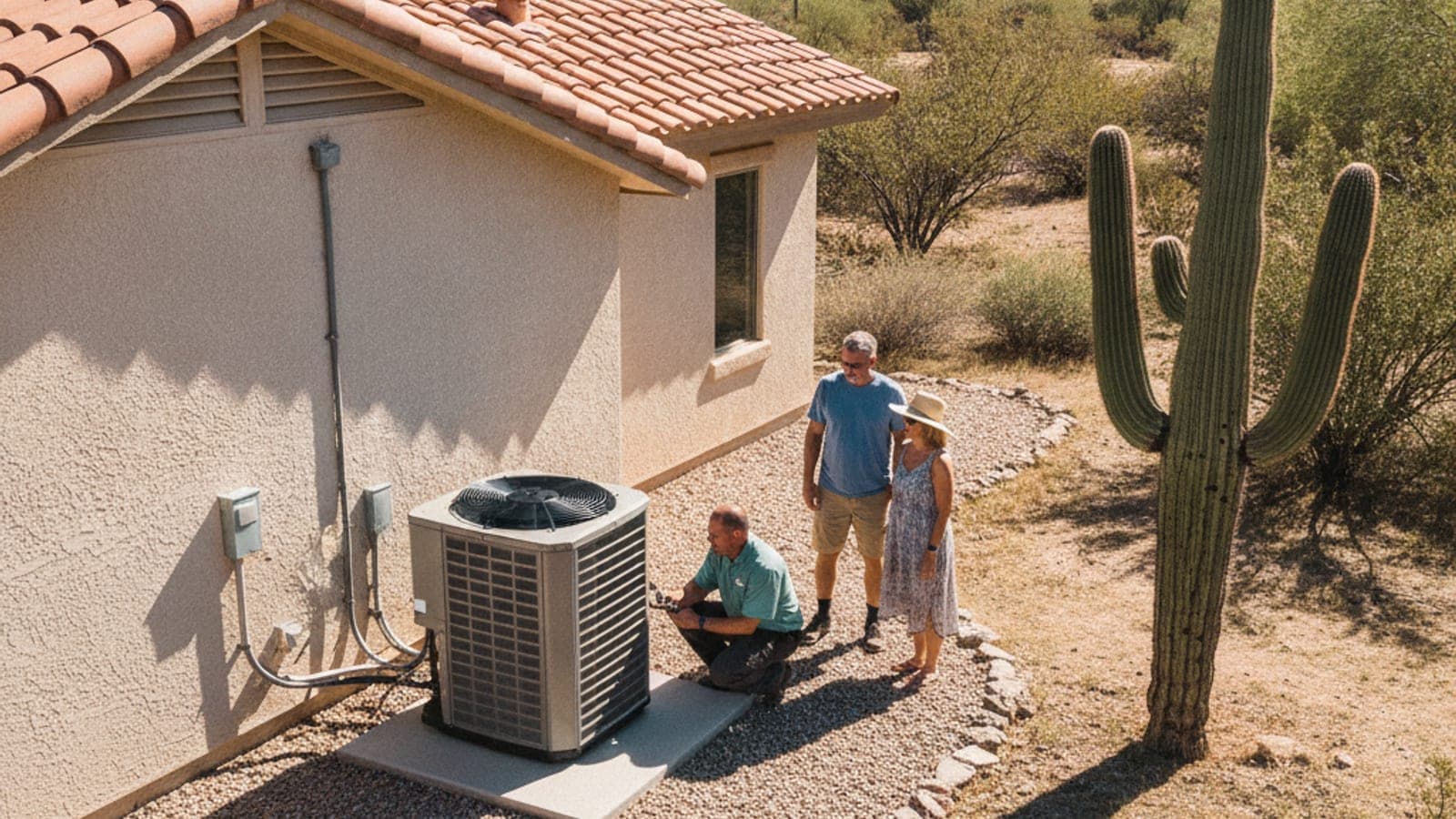
At 110F, a healthy Tucson AC can lose a few degrees through the afternoon and still be working as designed. The City of Tucson’s code uses a summer design dry bulb of 105F, so a 110F day asks for more than the equipment was sized to deliver. The useful test is the next ordinary day: if the house holds on a 95F afternoon, the drift was the weather. If it doesn’t, something’s wrong. Climate Pros Tucson matches you with licensed pros who can measure which it is.
This page is about the extreme afternoons. If the system struggles all summer, start with AC running but can’t keep up in Tucson heat.
How often does Tucson actually hit 110F?
Every year of the last decade, but only on a handful of days. Here are the counts at Tucson International Airport:
| Year | Days at or above 110F |
|---|---|
| 2016 | 5 |
| 2017 | 7 |
| 2018 | 3 |
| 2019 | 2 |
| 2020 | 8 |
| 2021 | 8 |
| 2022 | 2 |
| 2023 | 18 |
| 2024 | 6 |
| 2025 | 7 |
The hottest reading in those years was 116F on June 20, 2017. The all-time record is 117F, set June 26, 1990, per NWS Tucson. So a 110F afternoon is a few days a year, and 2023 was the outlier.
What does normal look like on a 110F afternoon?
- The system runs most of the afternoon without cycling off.
- The vent air still feels cool, even while the room temperature creeps up.
- The house climbs a few degrees above the setting.
- West-facing rooms run warmer than the rest.
- Recovery comes late. July’s normal low at the airport is 76.3F (1991-2020 normals), so the night gives the house little help and the setting may not come back until well after dark.
Which signs are a fault at any temperature?
Warm air from the vents, ice on the refrigerant lines, an outdoor fan or compressor that isn’t running, or a breaker that trips. None of those is the heat’s fault. Shut the system off if you see ice (AC freezing up), and see AC fan motor not spinning or AC tripping the breaker for the others.
How do you run the house on a 110F forecast?
- Cool a little deeper in the morning, before the heat builds, then let the setting drift a degree or two late in the day. On TEP’s Time-of-Use plan the summer on-peak runs 3 to 7 p.m. on weekdays, May to September, so finishing the extra cooling before 3 p.m. helps twice. The TEP time-of-use AC schedule lays it out.
- Close blinds on the west side by early afternoon.
- Don’t drop the setpoint sharply at 4 p.m. The system can’t cool faster; it only runs longer.
- Swap a dirty filter and keep the outdoor unit clear of debris, with the power off.
- If an older adult is home, the CDC advises staying in an air-conditioned building in hot weather and not relying on a fan as the main cooling. If the house won’t stay cool, go somewhere that does.
What should a pro check if it fails on ordinary days too?
Ask for the temperature drop across the indoor coil, the refrigerant charge and the condition of the outdoor coil. Ask whether the unit was sized by calculation; the City of Tucson requires load and sizing calculations for new and replacement equipment. Those three answers separate an undersized or failing system from one that just met a 110F day. See AC repair and the Tucson HVAC hub.
When 110F isn’t the whole story
If the house won’t hold on a 95F day, or the vents blow warm, call (520) 353-2520 and we’ll match you with a licensed local pro.